 rizky-amelia
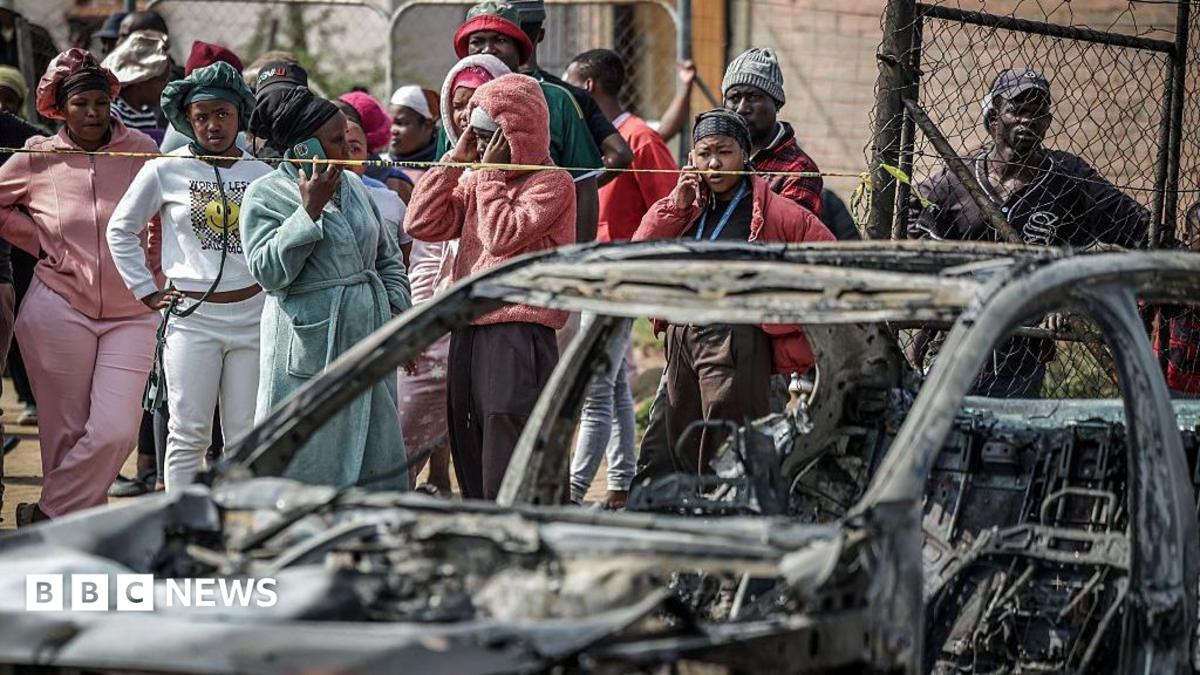
South Africa is counting the dead after a weekend of lethal gun violence that left 27 people killed in two mass shootings barely hours apart, with a further 26 wounded and no arrests reported in the immediate aftermath.
The first attack unfolded on Saturday evening close to Johannesburg, where eight gunmen descended on a bar in a crowded social setting. Seventeen people were killed in the assault, and another 15 were injured, according to reports from the scene.
Witnesses and officials described a sustained attack rather than a burst of opportunistic gunfire. The gunmen reportedly opened fire on customers gathered outside the venue, then pushed their way inside and continued shooting. As they left the scene, the attackers set fire to two vehicles, a detail that investigators will examine for clues about how the group arrived, moved and escaped.
Police said the victims included 13 men and four women. Officers stressed that the motive for the attack was not clear, and that no explanation had yet been established for why the group targeted the bar or what precipitated the shooting.
The second attack came in the early hours of Sunday morning, roughly 600 kilometres away, when gunmen opened fire outside an entertainment venue in a township near Cape Town. Ten people were killed and 11 more were wounded. Authorities said five victims died at the scene and five died in hospital, a pattern that frequently stretches emergency response times and puts additional pressure on already strained local medical services.
Armed security personnel were deployed across the Cape Town scene on Sunday morning as police cordoned off the area and began investigations. As of that morning, no arrests had been made in either the Johannesburg or the Cape Town case.
The attacks came just days after a separate shooting in Durban, where gunmen stormed a house in the KwaMakhutha township and killed 11 people. That incident, like the weekend's killings, took place not in a war zone or in a dispute between rival political factions, but in a country where ordinary domestic and social spaces — a bar, an entertainment venue, a home — have become recurring targets.
That repetition has fed growing concern that the country's gun violence is not simply a steady, if tragic, background condition but a pattern that is worsening. South Africa has long recorded one of the highest murder rates in the world, with police statistics putting daily killings at roughly 60 in a population of about 62 million. The two weekend shootings alone account for a share of that daily average concentrated into a few hours.
Underlying the violence is the easy availability of illegal firearms. Weapons that circulate outside legal and regulated channels have been a feature of the country's criminal economy for decades, and police have long argued that cracking down on the supply pipeline — rather than only pursuing individual attackers — is the only route to reducing the body count.
Much of the recent violence is linked to turf wars between gangs competing over profitable illicit trades, with drug trafficking and illegal mining repeatedly identified as key flashpoints. Rival groups in these markets increasingly use automatic and semi-automatic weapons, and disputes that might once have been settled by street violence have escalated into what look like military-style operations against crowded civilian gatherings.
The political response has escalated in turn. In February, President Cyril Ramaphosa characterised organised crime as "the most immediate threat to our democracy, our society and our economic development" — language that frames criminal networks not simply as a policing problem but as a threat to the state's legitimacy and economic prospects. Earlier this year, the military was deployed alongside police in areas with the highest murder rates, a measure aimed at reducing armed violence in the worst-affected communities.
Whether such deployments can keep pace with the pace of shootings is the central question hanging over the weekend's killings. Attacks on public venues require investigators to reconstruct suspects' movements, establish whether the victims were the intended targets or caught in crossfire, and determine whether a motive exists at all — a task made harder by a lack of arrests, which in turn allows suspects to move between districts or jurisdictions before questions are answered.
The absence of any stated motive is itself significant. It reflects a form of violence in which the weapon, not the argument, is the message, and in which communities are left to absorb the losses without any accompanying explanation. For families of the 17 killed near Johannesburg and the 10 killed near Cape Town, that silence is likely to be as unsettling as the death toll itself.
Investigations into both attacks were continuing on Sunday, with police expected to canvass witnesses, review CCTV footage and trace the vehicles used to reach the two venues. The proximity in time and the apparent absence of any link between the two sets of gunmen will shape the inquiry, as will the question of whether the burning of vehicles in Johannesburg was an attempt to destroy evidence or merely part of the attackers' departure.
For now, the clearest signal from the weekend is a body count: 27 dead, 26 injured, and no suspects in custody, in a country whose leaders have warned that the violence threatens the foundations of democratic life.







Comments (0)