 rizky-amelia
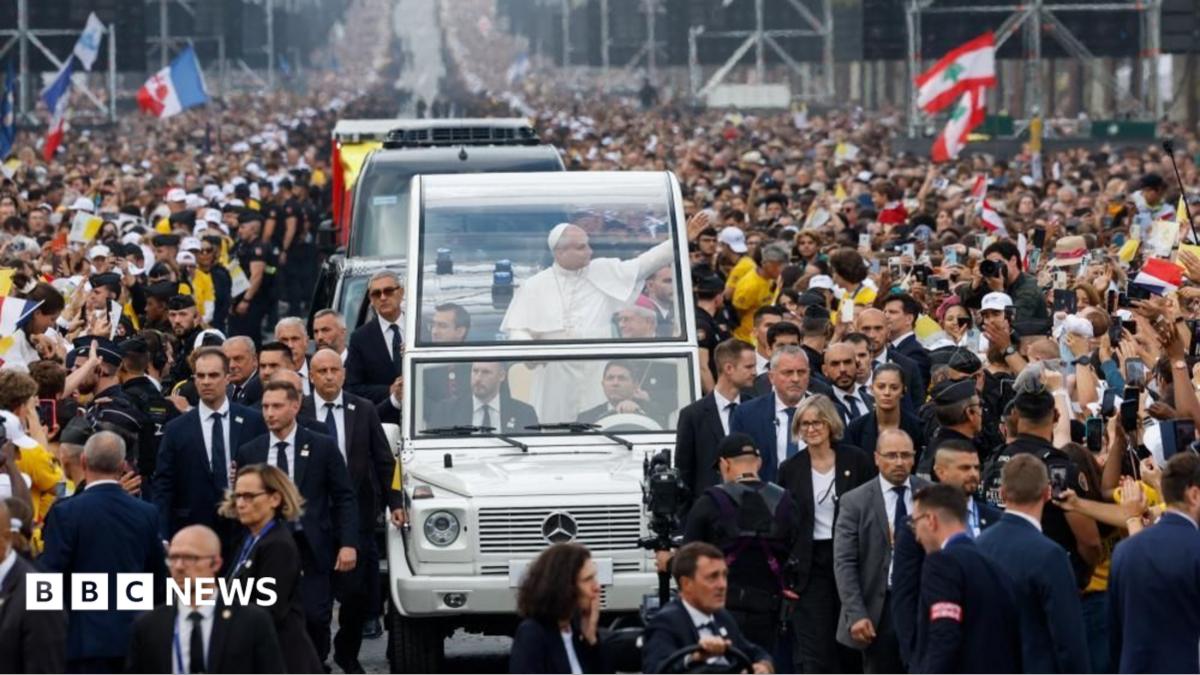
Hundreds of thousands of Catholics and curious onlookers filled the heart of Paris on Saturday as Pope Leo XIV celebrated a vast open-air Mass beneath the Arc de Triomphe, turning the Champs-Élysées into an open-air sanctuary for one of the largest religious gatherings the French capital has seen in years.
The pontiff travelled down the famous avenue in his popemobile, waving to crowds that lined the route and cheering as chants of "Leo, Leo" echoed along the tree-lined boulevard. Organisers expect more than half a million people to attend the event by the time the ceremony concludes, with a specially constructed altar erected on the Place de la Concorde to accommodate the scale of the celebration.
Video footage showed the Pope pausing at several points along the avenue to bless babies held up to him by parents in the crowd, a gesture that underscored the intimate moments punctuating an otherwise sprawling public event. Many in the crowd waved French flags, while others raised mobile phones and cameras to capture a glimpse of the Church's leader passing by.
The Mass, held in the open air rather than inside a cathedral, reflects both the expected size of the congregation and the symbolic weight the Vatican attaches to the visit. Church officials believe the turnout signals a renewed interest in spirituality among the French and other Europeans, a theme that has run through the pontiff's four-day trip to France.
The event has also drawn a notable political audience. Several candidates for next year's presidential election were expected at the Place de la Concorde, including Marine Le Pen of the hard-right National Rally and the conservative Bruno Retailleau, both of whom were photographed ahead of the ceremony. Centrist figures Edouard Philippe, the mayor of Le Havre and a former prime minister, and Gabriel Attal were likewise due to attend, alongside former prime minister François Fillon.
President Emmanuel Macron, who held an hour of talks with the Pope on Friday, will not attend any of the Masses during the visit. The decision is largely aimed at avoiding any breach of France's strict separation of state and religion, a principle known as laïcité that shapes the country's approach to public religious observance. In his place, First Lady Brigitte Macron and Prime Minister Sébastien Lecornu were present at the Champs-Élysées Mass.
Earlier on Saturday, the Pope turned his attention to one of the more vulnerable communities in French society, visiting the Maison Bakhita centre, an association that supports refugees and migrants. There, he praised the organisation for inviting people "to see those who are invisible," a remark that cast the Church's mission as one of recognition and inclusion.
During that visit, Leo spoke of the possibility of people from different backgrounds encountering one another and living together "in dignity and peace." He also emphasised what he described as the fundamental role of women in building what he called a civilisation of love, drawing a connection between social cohesion and the values he has sought to promote throughout his pontificate.
The Pope's engagement with migration and social inclusion comes at a time when immigration remains a politically charged subject across Europe, including in France, where debates over asylum policy and integration have intensified in recent years. His decision to begin the day at a refugee support centre before leading a mass in the capital's most iconic public square placed those themes at the centre of his visit.
The trip has not been confined to ceremonial duties. At the start of his visit on Friday, the Pope issued a warning about the dangers of artificial intelligence, cautioning against "losing our humanity amid a paradise of machines." The remarks, delivered to Church and state officials at the Élysée Palace, were wide-ranging and marked one of the more pointed interventions of his time in France.
That message appears to have been calibrated for a French audience grappling with rapid technological change and questions about the ethical limits of automation. By framing AI as a potential threat to human dignity, the pontiff positioned the Church as a moral voice in debates that are often dominated by engineers, economists, and policymakers.
Attention now shifts to the remainder of the itinerary. On Sunday, roughly 150,000 people have registered to attend a Mass at the sanctuary of Lourdes in the Pyrenees, one of the most revered Catholic pilgrimage sites in the world. The scale of the expected gathering there is comparable in significance to Saturday's event in Paris, if smaller in number.
On Monday, the Pope will travel to Metz in northeastern France, where he will pay tribute to Robert Schuman, a founding father of the European Union and a devout Catholic who is currently a candidate for beatification. The stop will link the visit to broader questions about European identity and the continent's Christian heritage, themes that have particular resonance in a country that has long debated the role of religion in public life.
Pope Leo XIV was born in Chicago in 1955 under the name Robert Prevost, a surname of French origin. His paternal grandmother was born in Le Havre in Normandy in 1894; when she later married in the United States, she and her Italian husband adopted the name Prevost, which had been her mother's maiden name. That personal connection to northern France gives added significance to the visit, particularly as the pontiff moves toward Metz and the regions beyond the capital.
For the Vatican, the scenes in Paris and the numbers expected in Lourdes offer evidence that religious observance retains a powerful pull in a country often described as secular. For French political leaders, the visit presents a delicate balancing act: acknowledging the cultural and historical weight of Catholicism while maintaining the constitutional separation that keeps the state at arm's length from organised religion.
Whether the enthusiasm on display along the Champs-Élysées translates into a lasting shift in French religious practice is a question no single event can answer. But for a few hours on Saturday, the avenue that usually carries traffic and tourists became a place of prayer and procession, with a crowd stretching toward the Place de la Concorde and the Pope at its centre.







Comments (0)