 rizky-amelia
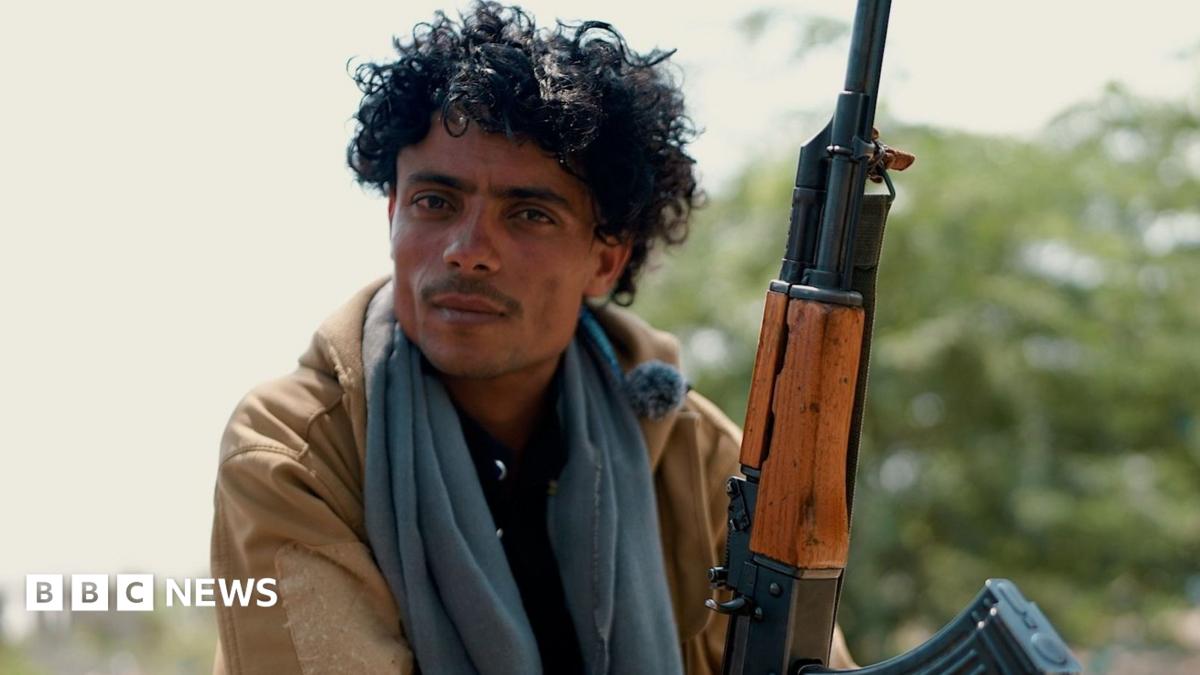
A soldier escorting a BBC team through the hills south-west of Taiz, Yemen's third largest city, looked up at the sky and offered a warning that proved prophetic. "This is the first drone," he said, adding that an attack usually follows. The buzzing overhead grew louder as the group crouched beneath bushes, then climbed back into a vehicle and drove off. Within roughly ten minutes, a sequence of heavy concussions followed one after another, though witnesses could not say where the strikes landed.
The encounter captured the daily reality of a front line that is far harder to define than any map suggests. In the mountains overlooking the city's southern approaches, the boundary between government-held and Houthi-controlled ground shifts with the shelling, and abandoned homes dot the slopes where families fled rather than endure the fighting. The normal din of traffic that usually fills Taiz's streets has largely drained away, replaced by an unsettling quiet broken only by livestock and the crack of incoming and outgoing fire.
The escalation followed the Houthis' capture of the Red Sea port of Mokha, 85km west of Taiz, on 10 September. The seizure came after a ceasefire that had largely held for four years unravelled, and it opened the way for the group to seize a swathe of high ground overlooking the Bab al-Mandab Strait, the narrow waterway through which a substantial share of global trade passes. Because the strait is the crucial shipping link between Europe and Asia, the move fed fears of further disruption to regional supplies and contributed to a rise in oil prices.
Analytical mapping by the Institute for the Study of War and AEI's Critical Threats Project, reproduced by the BBC, shows Houthi territory — shaded pink — covering much of western Yemen, including the capital, Sanaa, and extending south along the Red Sea coast to the approaches of the chokepoint. Contested zones cluster around the edges of that control. Enlarged views of the September offensive along the south-western coast place Taiz directly on the front line, illustrating how quickly positions have shifted this month.
The strategic stakes for the city are considerable. Taiz is Yemen's cultural capital and is home to close to a million people, and it sits at a vital junction between Houthi-controlled areas in the north and government-held territory in the south. Government forces hold the centre of the city, with Houthi positions to its north and east, leaving it hemmed in by front lines in several directions. The fiercest recent fighting has been on the western approaches, where both sides are contesting high ground overlooking the route south — terrain whose loss could make it far harder for government troops to retake Mokha.
Government-aligned sources told the BBC that the Houthis are consolidating troops in preparation for a major offensive. Officials acknowledged awareness of the threat and said their own forces were preparing as well, but the description from the front line suggests the two sides are watching each other across a few hundred metres of contested mountain.
At a checkpoint near the closest point of contact, a group of fighters had just returned from positions high on the slope, not far from advancing Houthi lines. One of them described the remains of 18 government soldiers lying in ground his unit could fire across but was unable to reach — a measure of how terrain, rather than firepower alone, is shaping this battle. "We shoot over them, but we can't pull them out," he said.
Civilians bear the brunt of such stalemates. Ali, who gave only his first name because he fears retribution if the Houthis take the area in coming days, remained at his home about 1km from the front line after two mortars struck his property. He sent his children to a displacement camp because they could no longer cope with the shelling, but stayed behind with his wife and sisters to tend their goats. He said he is terrified, but that he has no real choice, because without their animals the family would go hungry.
The route into Taiz revealed a second front — one of fragmentation. The BBC team travelled north from Aden, where Yemen's internationally recognised Presidential Leadership Council and government are based. Along the way, roughly 30 checkpoints marked stretches of road under the control of different commanders, a visible sign of the fractured composition of the forces fighting on the government side. Consolidation of authority on the Houthi side contrasts with a map of competing fiefdoms on the other.
As the convoy neared the city, ambulances began to overtake them. The crew counted at least five passing within half an hour, all heading toward Taiz's main hospital — evidence of a steady casualty rate arriving even as the pitch of the battle appeared, from the outside, to have briefly settled.
The contrast with ordinary urban life was striking after dark. Shops were lit, restaurants full, and children played in the streets. Every so often, the sounds of shelling and gunfire from the surrounding mountains cut through, reminding residents that the fighting on the ridgelines above them is never more than a few minutes away.
For the government side, the immediate prize is holding the western high ground; for the Houthis, it is completing a corridor from their northern strongholds to the shipping lanes of the Red Sea. Taiz sits between those two objectives, and with the four-year truce in tatters, the coming days carry risks for a city of nearly a million people that has already endured years of siege and bombardment.








Comments (0)