 rizky-amelia
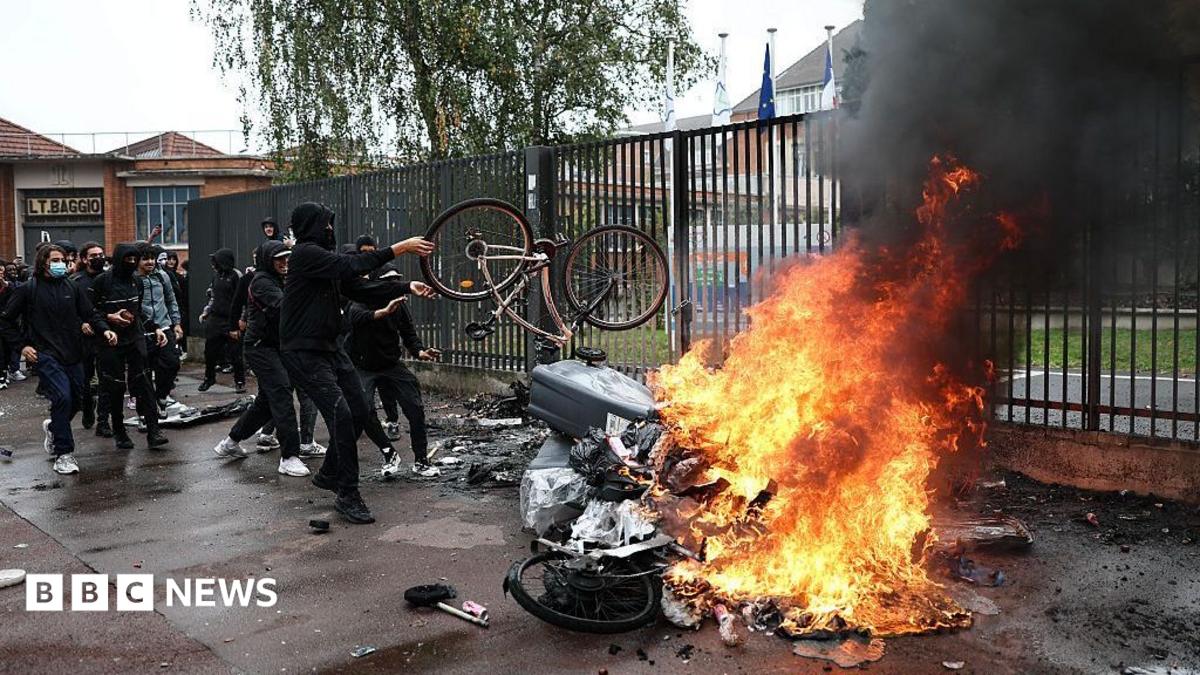
French authorities detained more than 400 people on Tuesday, the vast majority of them minors, after student demonstrations at high schools intensified across the country, Interior Minister Laurent Nuñez announced. The figure marked a sharp escalation from the previous day, when 164 people were arrested, underscoring how quickly a movement that began in the Paris region has grown into a nationwide phenomenon.
According to the interior minister, roughly two-thirds of those detained were placed in police custody, though he cautioned that officials had not yet finalized the full count. The protests affected at least 400 schools, according to the education ministry, with unrest reported from Paris to Lille and beyond.
The demonstrations stem from long-standing grievances within France's education system, including overcrowded classrooms and persistent teacher shortages. Students say conditions in their schools have deteriorated to the point where meaningful learning has become difficult. One 16-year-old female student told the AFP news agency that the movement was not about destruction but about drawing attention to a broken system. She described classes of 34 pupils and teachers who are overworked, saying the situation is simply not feasible.
What began last week in the Île-de-France region surrounding Paris has since spread to lycées across the country. These institutions are roughly equivalent to sixth-form colleges in the United Kingdom or high schools in the United States. In recent days, teenagers have blocked school entrances, set fire to rubbish bins, and damaged bus stops, according to photographs and video footage circulated from the scene. In Lille, students staged a blocking protest at the César Baggio secondary school, where black smoke was seen billowing from burning bins and bicycles.
The unrest has come at a human cost. Officials said at least ten teachers and several students were injured during Tuesday's demonstrations, along with 48 members of the law enforcement services. French media reported that protesters threw projectiles at police, who responded with batons and tear gas. The confrontations have raised questions about the proportionality of the police response, with several French politicians criticizing the tactics used against young demonstrators.
Interior Minister Nuñez rejected those criticisms, insisting that the police operation had been carried out in an extremely proportionate manner. His defense came as Ryad Rani, president of the Union Syndicale Lycéenne, which represents students, accused the French government of repression and the police of using excessive force. The competing narratives reflect a familiar tension in French public life, where the right to protest is fiercely defended but frequently tested by outbreaks of violence at the margins of demonstrations.
Education Minister Édouard Geffray acknowledged on social media that students have the right to protest, but condemned reports of violence as indefensible. Writing on Tuesday evening, he argued that the right to demonstrate is a fundamental freedom that cannot serve as an excuse for such actions. He warned that legitimizing the violence, or calling for the blockades to be extended, would endanger both students and public employees, describing such appeals as irresponsible.
The stakes were also emphasized a day earlier by Prime Minister Sébastien Lecornu, who warned that any escalation of the student protests would be irresponsible following Monday's arrests. Citing reported incidents that included fireworks, fires, and violence near high schools, he said nothing could justify endangering students, staff, or police officers. His intervention signaled that the government views the spreading blockades as a serious challenge to public order, even as it acknowledges the underlying complaints about school conditions.
Tuesday's student demonstrations coincided with nationwide walkouts organized by unions representing teachers, hospital staff, and civil servants. Those workers are protesting against low wages and difficult working conditions, adding a broader dimension to the day of action. Nuñez said the union-led protests, which reportedly drew at least 200,000 participants, mostly passed without incident. The contrast between the largely peaceful union marches and the confrontations around schools highlighted how the student movement has developed its own, more volatile character.
The scale of the detentions has drawn particular attention because most of those held are minors. France's treatment of underage protesters is governed by specific legal protections, and the decision to place so many young people in custody is likely to fuel further debate about the government's handling of the crisis. Critics argue that heavy-handed policing risks radicalizing a generation of students who are already frustrated by the state of their schools.
For the government, the dilemma is acute. Allowing the blockades to continue could encourage further disruption and embolden protesters, while aggressive policing risks inflaming public opinion and drawing more students into the movement. The education ministry's confirmation that at least 400 schools were affected suggests the disruption has already touched a substantial portion of the country's secondary education system.
Union representatives and student leaders have shown no sign of backing down. The Union Syndicale Lycéenne, which has helped coordinate the high school protests, framed the government's response as repression rather than public order management. With calls circulating on social media to extend the blockades, officials fear the coming days could bring larger gatherings and more confrontations.
The broader political context adds to the pressure on the government. France has experienced repeated rounds of industrial action in recent years over wages, working conditions, and public sector funding. The alignment of student grievances with union demands for better pay and conditions has the potential to broaden the movement's support base beyond high school pupils, turning a localized education dispute into a wider challenge for the administration.
Whether the protests remain a short, intense flare of discontent or evolve into a sustained campaign may depend on how the government responds in the next few days. Ministers have so far combined appeals for calm with firm policing, a strategy that has yet to restore order around the affected schools. For the students blocking entrances and the authorities tasked with clearing them, the coming week is likely to test both the limits of the right to protest and the government's willingness to address the conditions that sparked the unrest in the first place.







Comments (0)