 rizky-amelia
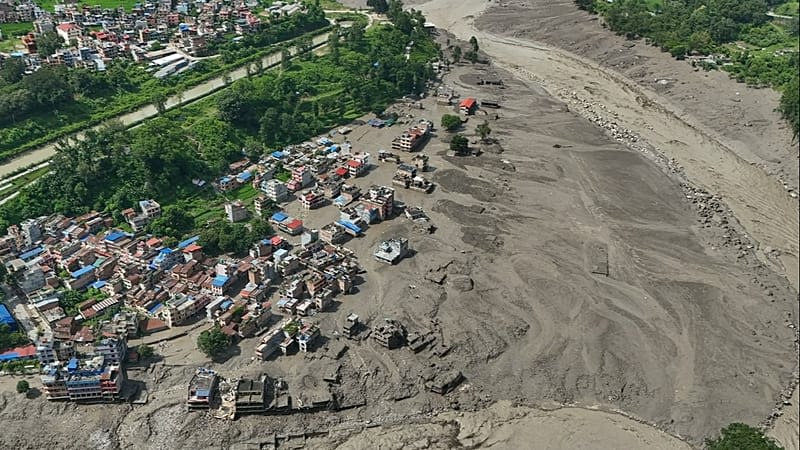
A devastating flash flood has swept through a mountainous stretch of Nepal along its frontier with Tibet, killing at least 19 people and leaving close to 400 travellers — the majority of them foreign visitors — unreachable, officials said on Wednesday.
According to the Nepal Tourism Board, a preliminary tally compiled from tourism operators and travel agencies lists 384 people as missing across the affected areas. Of those, 291 are foreign nationals and 93 are Nepali citizens. Authorities stressed that the figures remain provisional as teams work to confirm where each traveller is and whether they are safe.
Nepali police spokesperson Abi Narayan Kafle confirmed that 19 bodies had been recovered so far. He said rescue and relief operations were being coordinated intensively, adding that a number of police officers deployed to the area had themselves lost contact with their commands.
Footage circulated online by police and other witnesses showed churning walls of brown water tearing down Himalayan valleys in the district straddling the Chinese border. Suman Chalise, a 34-year-old teacher who saw the deluge strike in Nuwakot district, told AFP he watched the flood carry off eight or nine trucks together with homes and people caught in its path. Describing the scene as deeply distressing, he said he had never before seen destruction on such a scale.
Earlier, the police spokesperson acknowledged that the full extent of the damage was not yet known, but said residents living close to riverbanks had been warned to move to safer ground. The flood struck along the Trishuli River, where images taken afterwards showed wrecked buildings and vehicles scattered across the debris-strewn banks.
The Nepal Army said it had sent helicopters and specialised disaster response teams into the stricken zone to support search and recovery efforts.
The disaster has also knocked out a significant share of the region's power infrastructure. The Nepal Electricity Authority estimated that roughly 430 megawatts of generation capacity — drawn from both hydropower plants and solar installations — had been damaged. In a statement, the authority said production, transmission and distribution facilities had all been affected, cutting off electricity supplies to parts of the area.
Experts are still piecing together what triggered the torrent. Sarthak Shrestha, a remote sensing and geo-information analyst at the Kathmandu-based International Centre for Integrated Mountain Development (ICIMOD), said an initial review of satellite data found no unusual activity on the Chinese side of the frontier. Instead, he explained, researchers believe a rock-ice avalanche took place within Nepal itself, damming the Lhende river until it burst and unleashed the cascading flood downstream.
Several highways have been shut as a precaution, according to Nepali authorities, hampering access for rescuers.
Across the border, Chinese state broadcaster CCTV reported that a mudslide on the Nepalese side had caused significant casualties and left people missing around the Gyirong Port crossing in Tibet, an important trade gateway between the two countries. Footage broadcast by the network showed fast-moving water hauling branches and rubble along a submerged roadway.
Chinese President Xi Jinping has called for rescue work at full scale, state news agency Xinhua reported, though no figures for casualties on the Chinese side were given. Citing CCTV, Xi said the most pressing priority was to spare no effort in locating the missing, provide rapid treatment to anyone injured and keep the loss of life as low as possible.
Traffic officials in Tibet's Shigatse region warned on social media Wednesday that roads nearby faced a threat of mudslides and were unsafe to travel. The same crossing was hit by disaster only a year ago: Xinhua noted that 17 people disappeared following a mudslide close to Gyirong Port in July 2025.
Each year, monsoon rains falling between June and September bring deadly flooding and landslides to communities across South Asia, and this week's catastrophe adds to a grim seasonal toll.--- END ---






Comments (0)