 rizky-amelia
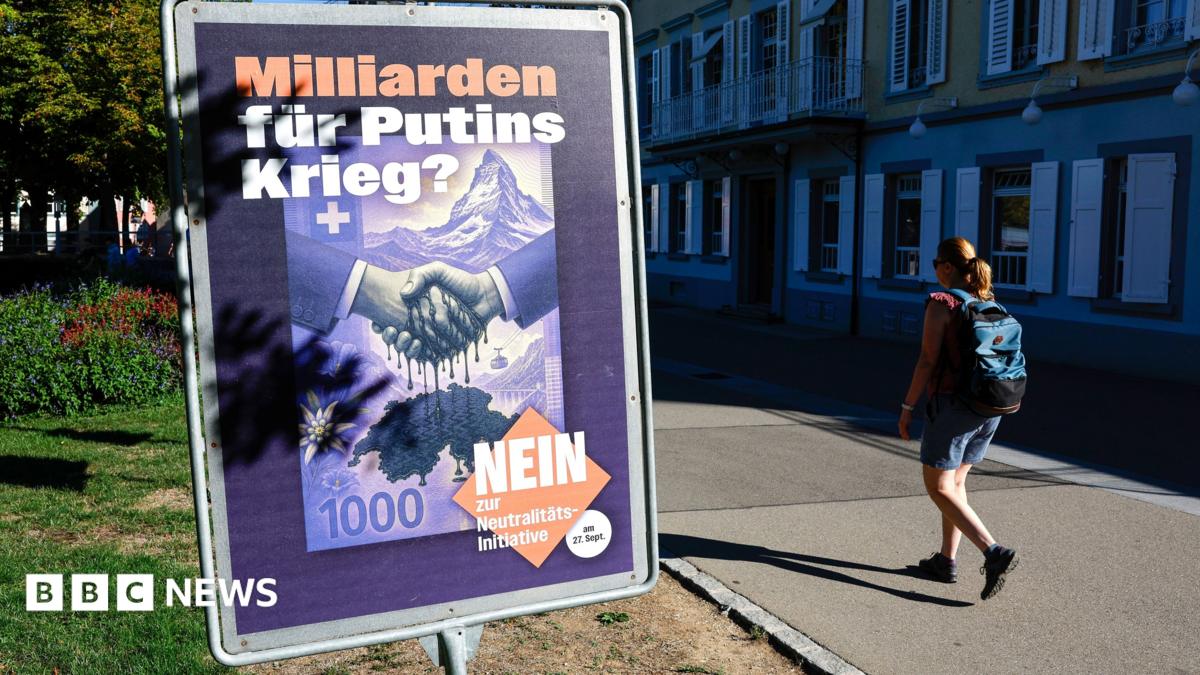
Swiss voters have decisively opted against tightening the country's centuries-old tradition of neutrality, backing a government position that the doctrine is flexible enough to permit sanctions on aggressor states. Official results showed more than 70% of those voting rejected the "Neutrality Initiative", a package of proposals that would have compelled Bern to seek United Nations authorisation before imposing any sanctions and would have ruled out closer alignment with the NATO military alliance.
The campaign drew unusual attention from abroad, with Moscow openly backing the initiative in what analysts described as a transparent attempt to widen Europe's internal divisions. At home, the measure was supported by the right-wing Swiss People's Party (SVP) and opposed by the federal government and every other major party — a rare show of unity that left the outcome largely settled before voters went to the polls.
The result lands at a moment when Russia's full-scale invasion of Ukraine has reopened a debate that had largely been settled in Swiss political culture. For decades, neutrality was treated as a settled feature of national identity rather than an active policy question. The war in Ukraine turned it back into a live controversy, pitting those who argued Switzerland's credibility as a mediator depended on not being seen taking sides against those who insisted the doctrine obliged the country to stay outside the sanctions politics of its European neighbours.
Lukas Golder, co-director of the research institute Gfs.bern, told Swiss public broadcaster SRF that the vote should not be read as Switzerland turning its back on neutrality. In his reading, the outcome showed voters had instead affirmed their support for measures aimed at Russia, and he pointed to what he described as a settled public understanding of the doctrine's purpose. "People have a clear idea of what Switzerland's neutrality is supposed to achieve," he said.
That interpretation, if accurate, suggests Swiss voters see neutrality less as a blanket prohibition on taking action and more as a framework for being a credible outside party — one that can act on international rules when they are flagrantly violated. It is a reading consistent with the government's own defence of its position, and it helps explain why a proposal framed as a defence of tradition ended up being voted down as an abandonment of it.
Foreign Minister Ignazio Cassis made that case during a televised debate ahead of the vote, arguing that "neutrality has always been applied with a degree of flexibility." His framing was careful rather than absolutist: the government had no intention of abandoning the doctrine, but equally no intention of treating it as a reason for inaction. He stressed that Switzerland has no plans to lift its ban on selling arms to countries in conflict, Ukraine included, and said plainly that "neutrality does not mean indifference."
Cassis also tied the question to Switzerland's own security environment, arguing the country would "not look away when we see violations of the very international rules that allow us to live in peace." The argument implicitly places Switzerland alongside the wider European project of defending a rules-based order, of which the country is a longstanding member in other respects, even while remaining outside the military structures that dominate that order.
The historical weight behind the debate is considerable. Switzerland's neutral status was internationally recognised in 1815, when the country was granted what was then called "eternal neutrality" at the Congress of Vienna, amid a period of war and upheaval across Europe. It was later given a legal definition in the Hague Convention of 1907, which forbade Switzerland from supplying weapons to countries at war — a provision that remains directly relevant, as the country previously rejected a request from Germany for ammunition for tanks being sent to Kyiv.
The same neutrality also shaped Swiss conduct during the Second World War. The country stayed out of the conflict, but banked gold looted by the Nazis and, in a move designed to deter an invasion by Nazi Germany, turned away thousands of Jewish refugees. These policies were formally apologised for in the 1990s, and they remain a reminder that a doctrine of even-handedness can carry severe human costs when applied without moral urgency.
Because Switzerland operates a system of direct democracy, questions of this kind are routinely put to the electorate rather than settled by parliament or the government alone. Major political decisions are frequently deferred to voters through referendums, which is why the campaign played out in public debates and why the arguments of figures like Golder and Cassis carried so much weight.
The vote nonetheless carries implications. For Bern, the result locks in a middle path: Switzerland retains its arms-export restrictions and its outsider status, while retaining the political room to join coordinated sanctions on Russia. For the SVP and its Moscow sympathies, it is a rebuke, and a sign that Swiss voters are unwilling to trade a valued international role for closer ties to the Kremlin. For the wider diplomatic debate, it is a reminder that Europe's neutral states remain capable of aligned action without formally surrendering the neutrality that underpins their distinctiveness.







Comments (0)