 hendra-wijaya
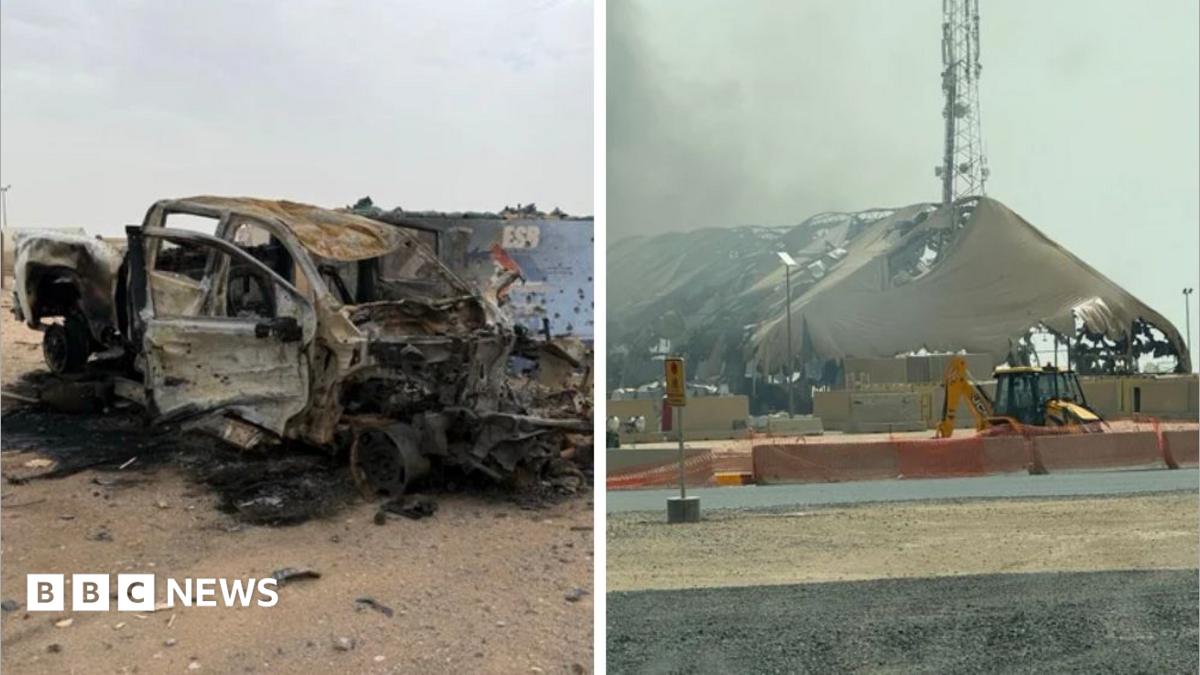
Newly emerged photographs shared by active-duty American military personnel have exposed extensive devastation across United States military installations in the Middle East following a series of Iranian attacks. The imagery, obtained by CBS News, provides a stark visual record of the physical destruction inflicted on strategic installations across the region, including sites located in Saudi Arabia and Kuwait.
The collection of undated photographs details severe damage to key military hardware and infrastructure, featuring flattened living quarters, crushed operational buildings, and a high-value surveillance aircraft torn apart on an airfield. The visual material offers an unfiltered look at the operational hazards and material devastation experienced by American forces deployed in the regional theatre.
Service members stationed at the affected facilities voiced frustration over what they described as an absence of transparency regarding the true scale of the onslaught. An unnamed military member told CBS that the significant level of destruction sustained by American installations had been kept from the public, remarking that personnel were left standing vulnerable with their eyes closed while enduring direct blows.
Among the most striking visuals is a ruined Boeing E-3 Sentry early warning aircraft stationed at Prince Sultan Air Base in Saudi Arabia, situated roughly 62 miles (100 kilometres) south-east of Riyadh. The photograph depicts the advanced radar jet cleanly torn in two, with its aft section crushed into a chaotic wreckage of twisted metal on the tarmac.
The Boeing E-3 airborne early warning and control system (AWACS) is an essential surveillance platform engineered to identify and monitor potential aerial and maritime threats at extended ranges, giving commanders vital advance warning. While the leaked photograph bears no date, earlier reporting and verification from BBC Verify confirmed that a matching image of the same compromised radar plane circulated around March, a period during which a US official informed Reuters that an Iranian strike on the Saudi installation had injured 12 American service members, two of them critically.
Additional photographs capture the severe fallout from strikes at Camp Buehring in Kuwait. One image shows a destroyed motor vehicle, while other pictures document collapsed trailers and the remnants of a large tented structure reduced to ribbons as dense smoke poured into the air across the compound.
Another installation in Kuwait, Camp Arifjan, also appears in the image release, showing exterior structural damage to a four-storey building. While structural impairments at Camp Arifjan—including disruptions to critical satellite communications equipment—were initially reported in March, it remains unclear if the photograph captures the aftermath of that specific bombardment or a separate incident.
The release of the images comes amid silence from military authorities regarding specific operational impacts. When approached regarding the photographs, the White House referred inquiries directly to US Central Command, which did not immediately provide a formal response or statement.
Security analysts argue the visual evidence exposes critical deficiencies in the posture of regional defences. Brian Katulis, a senior fellow at the Middle East Institute who previously served as a national security official under both Democratic and Republican administrations, observed that the physical aftermath demonstrates the United States failed to properly ready its protective infrastructure against incoming salvos.
Katulis further highlighted that compelling evidence suggests foreign adversaries, specifically China and Russia, may have assisted Iranian forces with targeting intelligence. He also criticised the Trump administration for failing to take meaningful action to rectify these identified defensive vulnerabilities.
The leaked photographs surfaced immediately following the release of a comprehensive report from the Pentagon's internal watchdog. That oversight assessment confirmed that Iranian barrages have struck, damaged, or completely demolished hundreds of individual structures and facilities across American bases in eight regional nations: Kuwait, Bahrain, Qatar, the United Arab Emirates, Saudi Arabia, Iraq, Oman, and Jordan.
According to the watchdog's figures, the broader conflict has imposed a massive financial burden, with total US expenditure reaching $33.4bn (£24.7bn) through 29 June. The watchdog report calculated that direct military equipment losses have climbed to $3.7bn (£2.8bn), noting that dozens of American aircraft were either ruined or impaired during the months following the outbreak of hostilities, including five refuelling planes destroyed or damaged on Saudi soil by Iranian ordnance.
Further economic and logistical context was outlined in an independent assessment from the Congressional Budget Office (CBO). The CBO highlighted that because the Boeing E-3 Sentry is no longer being manufactured, replacing the destroyed platform will necessitate transitioning to the newer E-7 model, with a single E-3 carrying a replacement cost of $500m (£371m).
The CBO calculated overall combat hardware losses—encompassing uncrewed drones, manned aircraft, and a Terminal High Altitude Area Defense (THAAD) missile battery—at approximately $1.9bn (£1.4bn). The agency pointed out that its calculations contained inherent uncertainties, noting that the Department of Defense declined to respond to formal inquiries for details, forcing analysts to assemble their findings from existing public records and government databases.








Comments (0)