 rizky-amelia
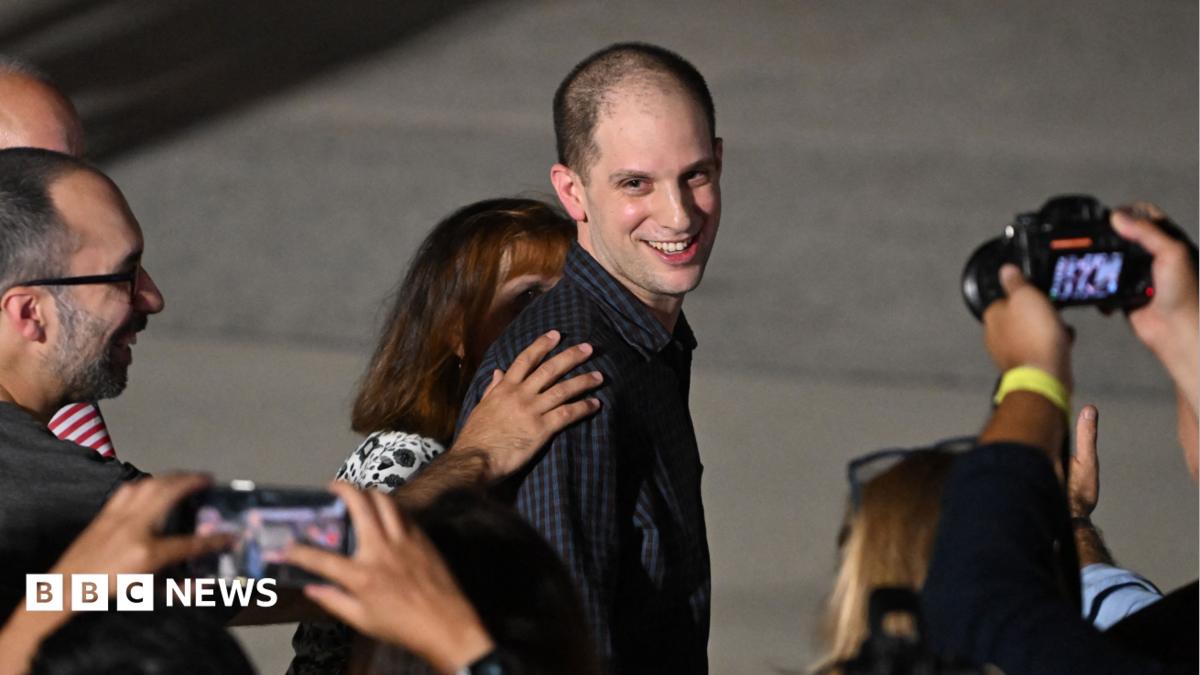
US journalist Evan Gershkovich has spoken in detail about the instant he understood he was being framed by Russian security services, describing the chilling realisation that he had walked into a carefully orchestrated trap. In an interview with BBC Radio 4's Today programme, the former Wall Street Journal correspondent said masked FSB agents surrounded him at a restaurant in 2023, leading him to conclude almost immediately that the espionage accusation against him was fabricated.
"It's at that moment that you realise it's something really serious," Gershkovich recalled. "When it's the FSB, you know it's been planned." The Federal Security Service, or FSB, is Russia's domestic security agency and successor to the Soviet-era KGB, and its involvement signalled to the journalist that his arrest was not a random incident but a deliberate operation designed at the highest levels.
Gershkovich, now 34, had been living in Russia since 2017 and was serving as the Journal's Moscow correspondent when he was detained. He was accused of espionage, a charge he and his employer have consistently rejected as false. He was ultimately sentenced to 16 years in prison, but was released 16 months later as part of a high-profile prisoner swap in August 2024. He is now based in Berlin, Germany.
Recounting the day of his arrest in Yekaterinburg, a city roughly 1,600 kilometres east of Moscow, Gershkovich said he had been meeting someone he believed was a source for a story. The two were sitting in a half-empty dining hall when approximately half a dozen masked men marched in and announced, "I think we booked that table." At first, the phrase struck him as odd, but on reflection he recognised its tactical cleverness - it was designed to "freeze you in place."
The men stood up, and Gershkovich was informed he was under arrest. The man he had been meeting vanished into the crowd, reinforcing the journalist's suspicion that the entire encounter had been staged from the beginning. It was, he said, a moment of clarity: he knew he had been lured into a trap.
Yet what followed was not the brutal treatment often associated with Russian detention of suspected spies. Gershkovich was neither interrogated nor tortured, a departure that he found strangely reassuring. "I have this odd moment - a sense of relief flooding over me," he said. "I realised they're not treating me like a real spy. They've set me up and fabricated this case so that I can be a valuable hostage, a pawn in a greater game."
That realisation, he explained, helped him remain "stable and disciplined in prison" and gave him a framework for predicting what might come next. He reasoned that his status as a foreign correspondent for a major American newspaper meant his detention would provoke international outrage, and he suspected a prisoner exchange was the ultimate objective.
He was right. Media organisations worldwide covered the case, his face appeared on a billboard in Times Square, and then-US President Joe Biden declared he had "no higher priority" than securing Gershkovich's release. The journalist believes this publicity was precisely what Moscow wanted - a high-profile captive to trade for one of its own. In the eventual swap, Russia received Vadim Krasikov, an assassin who had been serving a life sentence in Germany.
"They got away with it in the sense that there were no sanctions imposed," Gershkovich said, reflecting cynically on Moscow's strategy. "And so they played it really smart, if you think about it cynically."
During his detention, Gershkovich was held in Moscow's notorious Lefortovo jail, a facility that has housed many of Russia's most prominent political prisoners and dissidents over the decades. During Joseph Stalin's Great Terror in the 1930s, torture and execution were routine there. Gershkovich described the experience as "really isolating," confined to a tiny space. "That wears on you psychologically," he said, though he acknowledged that he was treated relatively decently: "I was allowed to sleep, the food was fine."
He deliberately smiled for cameras during his court appearances in Moscow, aware that images would be broadcast around the world. That, too, was a calculated act. "I wanted to show people this kind of defiance," he said. "We know that this is a fabricated case, and so if this is a game of theatre, let's not let them have it play out the way they want it to."
At the same time, Gershkovich was careful to note that his experience was not representative. "Some people get tortured," he said. "They get broken as human beings, deprived of food, of hot water for showers, told that they're never going to see their families again. I was treated completely differently." He pointed to the case of Ukrainian journalist Viktoriia Roshchyna, who died in Russian captivity in 2024 at the age of 27. When her body was returned months later, it reportedly showed signs of torture and her organs had been removed.
Gershkovich said he learned a prisoner swap was in the works about three weeks before it occurred, a period he described as "excruciating" because "every day is painfully long." When the exchange finally took place on 1 August 2024, it brought "pure joy" - but that euphoria was short-lived. "The joy fades, the adrenaline subsides, and you're faced with the reality of having to return to normal life again," he said, describing the aftermath as a difficult and sometimes overwhelming adjustment.
His account offers a rare window into the mechanics of state-sponsored hostage-taking, in which legal proceedings serve as theatre and prisoners become bargaining chips in geopolitical negotiations. Analysts have long argued that Russia's use of detained foreigners as leverage reflects a calculated strategy to extract concessions without incurring meaningful costs. Gershkovich's testimony appears to support that view.
His case also underscores the risks faced by journalists operating in countries where press freedom is constrained and where espionage charges can be levelled with little evidentiary burden. For newsrooms and press-freedom advocates, his release was a relief but not a resolution: other journalists remain detained in Russia, and the practice of using them as pawns shows no sign of abating.
Gershkovich's decision to speak publicly about his ordeal serves as both a personal reckoning and a warning. His story is one of survival, but it is also a reminder that the machinery that ensnared him remains intact.







Comments (0)